Gutrack
Quick Answer for Doctor Appointments: To keep an effective medical food log, record: (1) exact meal timestamps and ingredients, (2) symptom intensity on a standardized 1–5 scale, (3) postprandial latency (how many minutes passed between eating and pain), and (4) medication timing. Presenting a standardized PDF report eliminates recall bias and accelerates diagnosis.
The 15-minute consultation dilemma
Specialist medical appointments are notoriously short. When a patient sits down with a gastroenterologist and explains: "My stomach always burns and I can't figure out what causes it," the clinician faces a significant diagnostic challenge.
Without chronological data, physicians must fall back on empirical first-line protocols: prescribing standard-dose proton pump inhibitors (such as omeprazole or pantoprazole) and ordering an upper endoscopy weeks or months down the line. Weeks of potential dietary relief are lost to trial and error.
The 4 critical variables your doctor needs
To differentiate between acute gastritis, chronic GERD, biliary reflux, or functional dyspepsia, your doctor needs four specific data points:
- Timestamped Intake: Exact time of meal consumption, not just "lunch" or "dinner". Circadian timing plays a huge role in gastric acid levels.
- Ingredient Granularity: "Chicken sandwich" tells a doctor very little. "Grilled skinless chicken breast, white bread, light mayo, no raw onions" tells them the exact lipid and acid profile.
- Standardized Symptom Severity: Rating pain consistently from 1 (mild awareness) to 5 (debilitating flare preventing normal activity) establishes whether conditions are improving or worsening.
- Medication Corroboration: Documenting whether an antacid, H2 blocker, or alginate provided temporary relief helps clinicians verify whether acid is the true mechanical driver.
The postprandial reaction window
Understanding the exact time gap between eating and symptom onset is one of the most powerful diagnostic clues in upper gastroenterology:
- Immediate Reaction (< 15 minutes): Burning felt almost immediately after eating or swallowing strongly points to direct esophageal irritation (erosive esophagitis, open esophageal ulcer) or mechanical spasm.
- Early Gastric Window (30 – 60 minutes): Pain developing as the stomach stretches and begins pumping hydrochloric acid is classic for gastric ulceration or acute gastritis of the antrum.
- Delayed Gastric Window (90 – 240 minutes): Reflux or burning that appears several hours later typically reflects delayed gastric emptying (gastroparesis), excess lipid ingestion slowing transit, or nocturnal recumbency.
Biometric context: Sleep and heart rate
Digestive flares do not happen in a vacuum. Sleep deprivation elevates cortisol, reducing blood flow to the protective stomach lining and lowering pain thresholds. Gutrack connects with Apple Health to display sleep duration and resting heart rate alongside daily logs, offering your physician a complete lifestyle picture.
Scratch notes vs Structured clinical reports
| Tracking Method | Patient Effort | Clinical Value for Doctor |
|---|---|---|
| Memory / Recall | EffortNone initially | Clinical ValueVery Low: Plagued by recency bias and emotional exaggerations. |
| Handwritten Notebook | EffortHigh: Constant manual writing | Clinical ValueMedium: Doctors rarely have time to read through 15 pages of messy notes. |
| Generic Calorie App | EffortHigh: Complex macro logging | Clinical ValueLow: Macros and calorie goals are irrelevant for stomach inflammation. |
| Gutrack Doctor PDF | EffortLow: 15-second taps & meal scans | Clinical ValueHigh: Standardized visual charts, trigger matrices, and latency correlations. |
How Gutrack exports doctor-ready reports
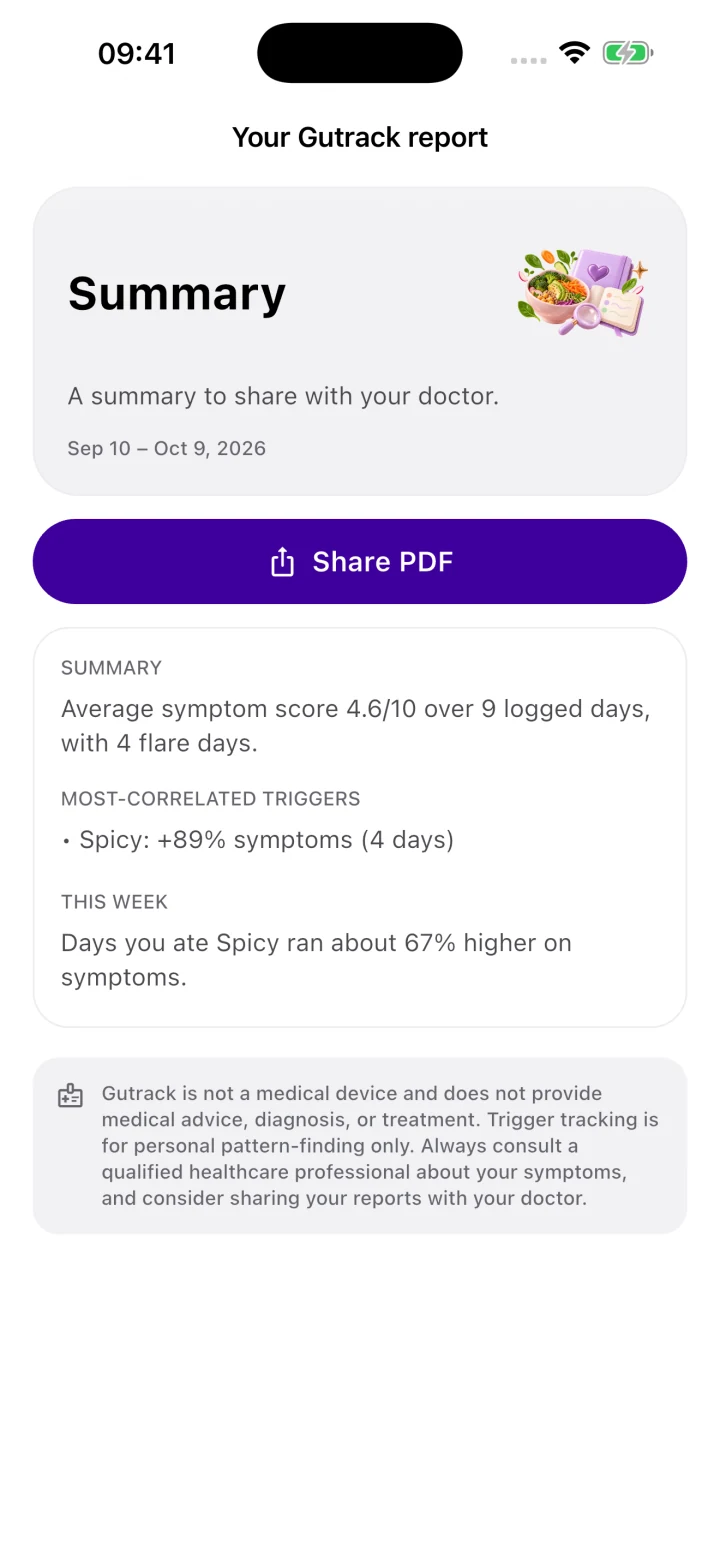
Instead of handing your doctor an unruly smartphone screen or an unorganized journal, Gutrack Pro compiles weeks of symptom check-ins, meal logs, and Gastric Safety Index scores into a clean, 1-page PDF document:
- A visual flare calendar showing pain distribution across days and weeks.
- Correlated food lists identifying top suspect meals.
- Average symptom scores and medication frequency.
- Ready to print or attach directly to your patient portal before your consultation.
A collaborative tool, not a replacement for medical diagnosis
A symptom diary is a powerful diagnostic aid, but it is not a diagnosis in itself. Always share your tracking logs with a board-certified gastroenterologist or primary care physician to investigate underlying etiologies.
Frequently asked questions
How long should you keep a food and symptom diary before seeing a doctor?
A period of 2 to 4 consecutive weeks of tracking provides doctors with enough longitudinal data to observe consistent patterns, isolate intermittent flare triggers, and evaluate the effect of medication cycles.
Why do gastroenterologists prefer structured reports over handwritten notes?
Physicians typically have only 10 to 15 minutes per consultation. Handwritten notes are often disorganized and suffer from recall bias. A structured report with chronological timelines, flare severity scales, and meal correlations allows the clinician to spot diagnoses in seconds.
What information is most critical to record during a flare-up?
Always record the exact onset time, the primary sensation (e.g. burning, gnawing, pressure, regurgitation), severity on a 1–5 scale, meals consumed 1 to 4 hours prior, and any medications taken (such as antacids or PPIs) and whether they provided relief.
Should medication timing be logged alongside meals?
Yes. Logging exactly when you took acid reducers (e.g. omeprazole, famotidine) relative to meal times is crucial. Many medications require taking them 30 to 60 minutes before the first meal to work effectively.
Can Gutrack export a PDF report directly for medical consultations?
Yes. Gutrack Pro allows users to export a standardized, clean PDF report summarizing symptom severity trends, meal logs, food safety distributions, and correlated flare triggers, formatted specifically for clinical review.
Sources & background reading
Background sources for causes, symptoms and treatment. Individual food tolerance varies; example scores are not a diagnosis. See our editorial standards.
Not sure which foods are safe to reintroduce? The free food checker lets you look up any food's GSI score instantly. For a broader view, consult our gastritis diet guide with evidence-based food lists.
This article is for educational purposes only and isn't a substitute for professional medical advice, diagnosis, or treatment. Gutrack is a self-tracking tool, not a medical device. If you're experiencing persistent or concerning symptoms, talk to a doctor.