Quick answer: Choose by condition and job, not by star rating. IBS needs bowel-movement and FODMAP tracking; GERD needs meal timing, reflux triggers and sleep context; gastritis needs mucosal irritants and meal scoring. The right app is the one whose core model matches your diagnosis and whose export your clinician will actually read.
Start with the condition, not the app
“Gut health” is not one problem. Three of the most common labels describe different mechanisms, and each asks a tracker to record different evidence:
- Irritable bowel syndrome (IBS) is a disorder of gut–brain interaction. Symptoms include recurrent abdominal pain and a change in bowel habits, without visible damage to the digestive tract. FODMAPs — fermentable carbohydrates — are one of several diet levers, and a low-FODMAP trial is usually supervised by a dietitian.
- Gastroesophageal reflux disease (GERD) is what happens when stomach contents repeatedly come back into the esophagus. Meal timing, portion volume, late eating and individual trigger foods matter more than calorie counts.
- Gastritis is inflammation of the stomach lining, most often linked to H. pylori infection or NSAID use. Diet is not thought to cause most cases, but individual foods can make symptoms worse during a flare.
| Main problem | What the tracker must capture | Useful extras |
|---|---|---|
| IBS | Must captureBowel movements, stool form, bloating, abdominal pain, food and portion context | ExtrasFODMAP guidance, dietitian export, stress tracking |
| GERD | Must captureMeal times, symptom latency, meal size, late meals, sleep, medication | ExtrasAcidity estimates, head-of-bed position, weight context |
| Gastritis | Must captureMeal composition, fat load, acidity, symptom timing, PPI or antacid use | ExtrasMeal scoring, ingredient breakdown, doctor-ready export |
Many people have more than one diagnosis. If you have IBS and GERD, pick the app that covers the job you most need to bring to a clinician — usually the symptom you cannot explain on your own.
Seven criteria that actually matter
Ignore the store ranking for a moment. These are the questions that decide whether an app survives past week two.
1. Condition fit
The app’s core object should be the thing you need to change. A calorie tracker’s core object is energy; a GERD tracker’s core object should be the meal-to-symptom timeline. If the home screen asks for macros before it asks how you feel, it was not built for you.
2. Time-stamped symptoms
Reflux often appears within 30–60 minutes of a meal; gastritis pain and delayed gastric emptying can show up two to four hours later. If an app only records “today”, it cannot separate those windows. Timestamps are not a detail; they are the analysis.
3. A scoring model you can inspect
A number without an explanation is a black box. Look for a page that names the inputs — acidity, fat density, known sphincter relaxers, portion size — and says plainly that the score is an estimate. Be sceptical of any app that presents a proprietary score as a medical assessment.
4. Medication logging
PPIs, H2 blockers and antacids change symptom timing. If you start omeprazole halfway through your log and the app has no place to record it, every correlation after that date is confounded.
5. An export your clinician will read
Ask what the export actually contains. A CSV of raw rows is useful for a researcher; a chronological PDF with symptom scores, meals and patterns is useful in a 15-minute appointment. Ideally you can see a sample before subscribing.
6. The privacy model
On-device storage means no account and no server copy — excellent for privacy, weaker for backup and multi-device access. Cloud storage enables sync and reports, but requires trust in the provider. Neither is automatically better; decide which trade-off you want, and check whether account deletion is self-service.
7. The price model
“Free” can mean free to download with the useful part behind a subscription. Before you commit, find out what is paywalled: scanning, history length, insights, exports, reminders. A tool that charges for the export you need for your doctor is a different product from one that does not.
What star ratings do not tell you
App Store ratings measure satisfaction, not clinical fit. They are shaped by onboarding, paywalls, pricing changes and the subset of users who bother to review. A small sample swings wildly; a large one can still belong to an app built for a different condition. Ratings also differ by country, store and date, which is why a list that quotes them without a date is not evidence.
“Best overall” is usually self-awarded. Treat it as a marketing claim, not a finding.
Where Gutrack fits
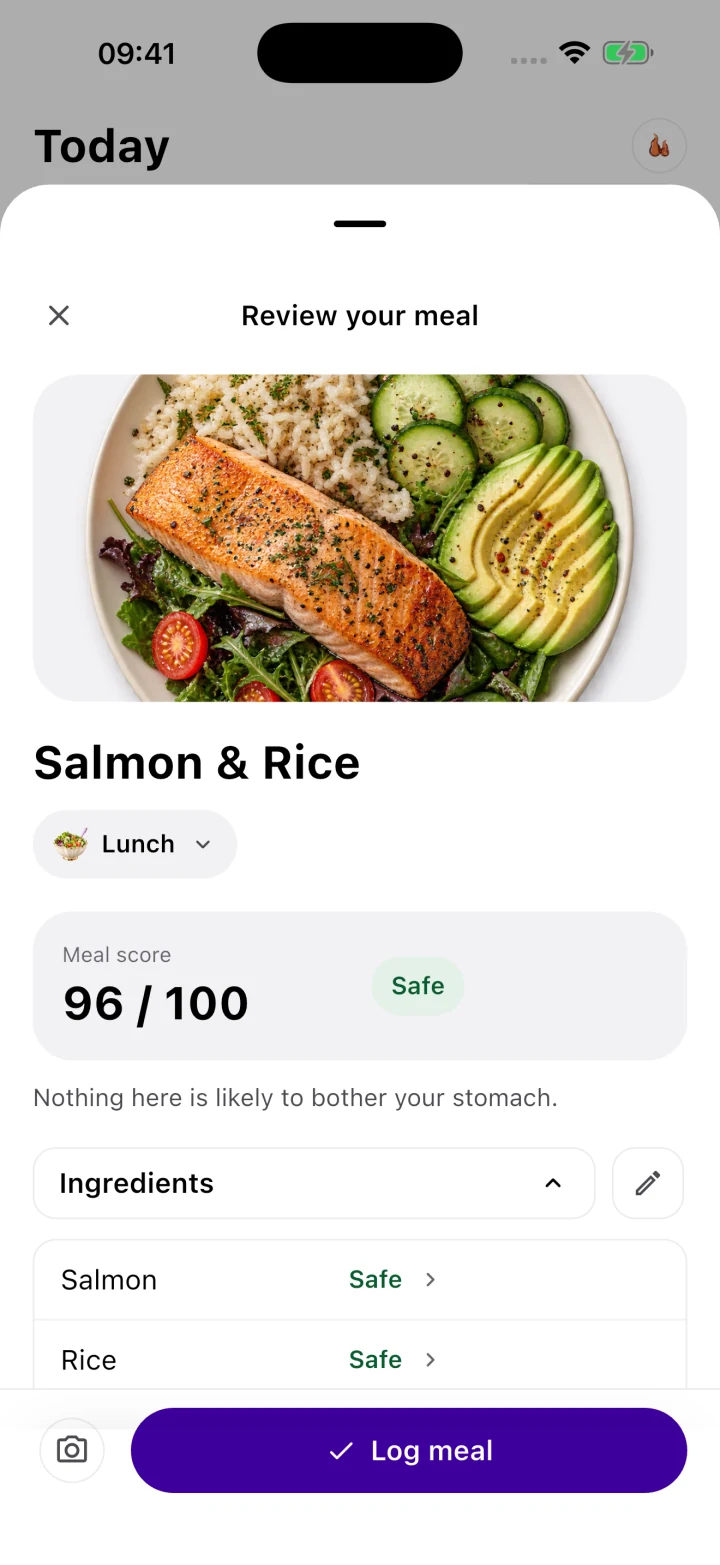
Gutrack is deliberately narrow: it is built for people managing gastritis, GERD and sensitive digestion on iPhone. Its core object is the meal, scored 0–100 with the Gastric Safety Index:
- Safe (70–100): a gentler choice on the scale.
- Caution (40–69): worth watching alongside your symptoms.
- High risk (0–39): a meal to pay closer attention to.
Around that score, Gutrack logs meals, drinks, symptoms and medication; scans a meal and breaks down ingredients; correlates sleep and heart rate from Apple Health; and exports a PDF report for a gastroenterology appointment. The score is an informational estimate, not a diagnosis.
 Gutrack
If your main question is “which meal did this?”, Gutrack is built for that question. It is not an IBS or FODMAP app.
Get Gutrack for iPhoneWhere Gutrack is not the right choice
This matters more than the feature list. If one of these describes you, a different tool will serve you better:
- You need a low-FODMAP elimination programme. Gutrack has no FODMAP database and no dietitian programme. Use a dedicated FODMAP app alongside a dietitian.
- You mainly track bowel movements. A diary built around stool form and frequency will fit IBS better.
- You want calorie, macro or weight-loss coaching. Gutrack scores gut tolerance, not energy balance.
- You want a diagnosis or a treatment plan. No app can provide that. Book a clinician.
- You use Android. Gutrack is iOS-only today; an Android version is in development but not available.
Six questions before you subscribe
- Does it capture what my clinician actually asks about?
- Can I export my history, and what does the export contain?
- Does it explain how its score is calculated?
- Can I log medication changes next to symptoms?
- Where is my data stored, and can I delete it myself?
- What stops working if I cancel?
If an app cannot answer those six, the star rating is doing the work that the product should be doing.
Frequently asked questions
Is Gutrack an IBS app?
No. Gutrack is built around gastritis, GERD and sensitive digestion. It does not include a FODMAP database or a bowel-movement diary, so a dedicated IBS app is a better fit if FODMAPs and stool patterns are your main concern.
What is the difference between the Gastric Safety Index and FODMAPs?
They answer different questions. The Gastric Safety Index estimates how gentle a meal is for the upper gut — acidity, fat load and sphincter relaxers. FODMAPs are fermentable carbohydrates that can trigger bloating and bowel symptoms in IBS. A meal can be low-FODMAP and still score poorly on the GSI.
Can a tracker diagnose gastritis or GERD?
No. Gastritis is diagnosed with tests such as upper endoscopy and H. pylori testing; GERD is diagnosed from symptoms, history and sometimes further tests. A tracker organises your history and helps a clinician, but it cannot diagnose either condition.
Do I need a subscription to use Gutrack?
Gutrack is free to download. Gutrack Pro unlocks scanning, full history, insights, PDF reports and reminders. Prices are shown in the app and billing goes through your App Store account.
Is diet the main cause of gastritis?
For most people, no. NIDDK notes that diet is not thought to play an important role in causing most gastritis; H. pylori infection and NSAID use are more common causes. Individual foods can still worsen symptoms during a flare, which is what a food-and-symptom log helps you find.
Sources & background reading
- NIDDK (NIH): Gastritis & Gastropathy
- NIDDK (NIH): Acid Reflux (GER & GERD) in Adults
- NIDDK (NIH): Irritable Bowel Syndrome (IBS)
Background sources for definitions, diagnosis and treatment. This guide is not medical advice, and no app comparison here is a clinical recommendation. See our editorial standards.
See how the Gastric Safety Index scores each food on a 0–100 mucosal-safety scale, or try the free food checker to look up any food instantly. If you want to prepare for a gastroenterology appointment, our guide on how to track food triggers for your doctor walks through exactly what to log.
This article is for educational purposes only and isn't a substitute for professional medical advice, diagnosis, or treatment. Gutrack is a self-tracking tool, not a medical device. If you're experiencing persistent or concerning symptoms, talk to a doctor.